RealGM Analysis
2011 Record: 12-4
Point Differential: +112
Turnover Margin: +8
Sack Differential: +8
Offense
2011 Ranks
Rushing: 12th
Passing: 18th
3rd Down: 7th
Scoring: 14th
QB: Here we find the quandary that is Joe Flacco. Coming into the final season of his rookie contract, Flacco has accomplished great feats. He has guided the team to several playoff wins and hard-fought victories over bitter rivals in important regular season games. He threw a picture perfect pass that had them in last year’s Super Bowl before it was dropped. No QB in history has won more games (44) in the first four seasons of a career, and his home record of 27-5 is the highest home win percentage in history. Flacco might have the strongest arm in the league and isn’t afraid to unleash bombs over the top of the defense, softening up the belly for pounding runs and checkdown passes underneath the safeties. His teammates trust in him and often rally around him.
Yet questions persist. Last year his completion percentage fell to 57% and his yards per attempt were the lowest of his career. He still takes too many sacks (average per year: 35), many of which are the direct result of Flacco holding the ball far too long. His TD/INT ratio is below average with a career 20/12 split per season. Flacco often comes across as dispassionate and aloof, and he’s the rare playoff-team QB who is better in the first quarter than the 4th. That the Ravens let Flacco get to a potential free agent walk year without coming close to a contract extension tells a very vivid story; they trust him to drive but aren’t quite ready to buy him his own car. This is the year for Joe Flacco to earn those keys. He must rebound to at least 60% completions and bump the yards per attempt back over 7, and throw at least twice as many TDs as INTs. Flacco certainly has the ability to do those things, but like his GM Ozzie Newsome I need to see it before I fully invest in him.
At least Flacco won’t feel pressure from below. Backup Tyrod Taylor is an athletic project who threw one pass as a 6th round rookie last year. Taylor is a chip off the Virginia Tech/Michael Vick block, a great runner with a cannon for an arm that gradually developed accuracy and field sense during his time in Blacksburg. He has some Seneca Wallace to his game and could have that same sort of long career as a functional backup who gets leapfrogged when the time comes for a long-term QB solution. Former Colts QB Curtis Painter joined his deposed head coach Jim Caldwell in Baltimore, with Painter fighting to stick as the #3 and Caldwell hoping to redeem his reputation as the new QB coach. I am not overly optimistic that either will find success here.
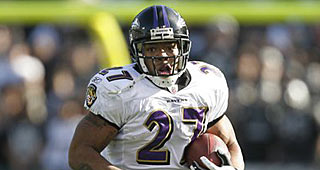
RB: Ray Rice is arguably the best running back in the game today, and certainly among the most versatile. Short but not small or timid, Rice is a dual threat in the backfield and ranks among the best at both running and catching the ball. As Rice goes, so goes the offense; the team went 9-1 when he topped 100 total yards last year but has just 3 wins over the last two seasons when he doesn’t hit the combined century mark. He led the league in yards from scrimmage with 2,068, including over 700 receiving yards. Almost all of those yards came on short dumpoffs and check downs; his average reception travelled less than one yard down the field and his legs were responsible for over 8 yards per catch. Rice also logged 4.7 yards per carry and scored 12 times, both among the league leaders. He almost never fumbles and has proven quite durable for the workload he takes. He belongs in the conversation for Offensive MVP annually. If you play fantasy football, I would strongly recommend Rice as one of the top 3 overall picks.
With Ricky Williams now retired and free to live life in a perpetual purple haze, there is a glaring hole at backup RB. Among the combatants in the camp battle to fill that void are 3rd round pick Bernard Pierce, seldom-used 2011 7th rounder Anthony Allen, and undrafted free agent Bobby Rainey. Pierce figured to have the gig all to himself but has missed most of camp with a hamstring injury, the sort that can linger for weeks and crimps explosion. He was a dominant touchdown machine at Temple, showing the ability to run both around and through MAC defenders. Pierce doesn’t have great speed but he attacks holes and packs good power at the second level. Allen is even more of a power back, a 230-pound thumper from Georgia Tech’s triple option. He got just 3 carries last year and will have to demonstrate more wiggle to earn more than that this year. Rainey has been one of the most pleasant surprises of any camp through mid-August. The diminutive Western Kentucky product has shown a Darren Sproles-like ability to embarrass would-be tacklers in space and the compact power to explode through arm tackles. I had a 6th round grade on Rainey at draft time and if he keeps fighting hard he could make that grade seem low. The team will give him as much work as he can earn. Young Damien Berry looks bound for the practice squad again, at best.
Vonta Leach is an elite lead blocker at fullback. Leach is a throwback to your father’s (or grandfather’s) thumping fullback, a seek-and-destroy blocker who treats the position like a linebacker and not a runner. He did get 12 carries in his first season in Baltimore, 11 more than he got in the prior three years in Houston. He is solid in pass protection as well and can catch the occasional swing pass. Interestingly, Leach was more effective as a lead blocker for Ricky Williams than Rice last year; Rice often explodes outside his blocks or past him at the point of engagement.
WR/TE: Starters Anquan Boldin and Torrey Smith could not be more different. Boldin is one of the most physical receivers in the league, a bull after the catch and arguably the best blocking wideout in the league. He trolls the 8-to-15 yard range over the middle, almost never running routes longer than that, and most of his catches are in heavy traffic. His yards per catch spiked up nicely to a career high 15.4 last year, but his catch rate (54%) and number of looks (104) both hit career lows for a healthy season. Boldin is entering his 10th season with a great deal of wear and tear on his body; even though he takes great care of himself, the decline in his effectiveness that began last year is likely to continue. For you fantasy geeks, those 57 receptions and 3 TDs last year are more what to expect than the 80+ catches and 5+ TDs a lot still expect from Boldin.
Smith was a controversial 2nd round pick last year, widely derided as a raw speedster with lousy hands and questionable toughness. He certainly has speed to burn, and he announced his presence with authority in ripping the Rams for 152 yards and three touchdowns in his debut game, including a 74-yard bomb where he blew past the cushion and still got a good five yards behind the DBs. But other than a couple of nice games against Pittsburgh and Cincinnati, Smith’s blazing speed was more used as a decoy and occasional incompletion down the field than anything functional; other than those three games, Smith had just two catches more than 30 yards and caught less than 45% of the balls thrown his way. Part of the lower catch rate has nothing to do with his hands, as he seldom runs patterns numbered lower than 7 (post/corner/fly)
The Ravens use 3+ WR formations less than any other team and throw fewer passes to non-starting wideouts than any other offense as well. That’s probably a good thing for this season, because the #3 wideout figures to be free agent acquisition Jacoby Jones. The long and speedy Jones flashed occasional playmaking ability in his Texans years but frequently drew the ire of fans and coaches for his wildly unreliable play. Because Jones does do things well at times, showing he can physically run great routes and make tough catches over his shoulder and below his knees, it drives everyone crazy when he saws off a route for no reason or lets a ball hit him in the facemask, which happened four times last year. It’s all mental with Jones and he has enough NFL tenure that it is unlikely to change even with a new team. Jones will make a handful of great plays but won’t top his 32 receptions from a year ago.
LaQuan Williams and Tandon Doss will fight for any remaining scraps. Doss has the draft pedigree (4th round in ’11), size, and sticky hands to emerge as a surprise contributor if he can ever get healthy, something he has yet to be in his brief Ravens career. If Jones falters, Doss will get the call to fill in and he could also contribute in the red zone. Williams has blazing speed like his Maryland teammate Torrey Smith, but caught just four passes in his rookie year and is fated more for special teams duty. The same is true of David Reed once he returns from a torn ACL that will likely keep him on the PUP list into the season. Rookie 6th round pick Tommie Streeter is raw as a route runner but has intriguing measurables.
Part of why the Ravens rarely throw to any non-starting wideouts is the presence of two quality pass catching tight ends in Dennis Pitta and Ed Dickson. The two of them are fairly interchangeable, both 6’4” and about 245 pounds with good speed and decent hands. They’re even part of the same draft class of 2010. Dickson was drafted to be more of a vertical threat but Pitta had a higher yards per catch average and better YAC a year ago, while Dickson settled for a pedestrian 9.9 yards per catch. Dickson was a solid target in the red zone, where he is a little more fluid getting to the outside and presenting a target for Flacco. The Ravens use the two TE formations nearly 35% of their offensive snaps and over 45% on first down, so there is definitely room for both to top 40 receptions and 550 yards this season…if they can get healthy. Pitta will miss the entire preseason with a hand injury, while Dickson separated a shoulder in the preseason opener and could miss regular season time as well. Davon Drew is trying to emerge from years on the practice squad, with former 49er Bill Bajema looking to stick as the #3. Bajema has some juice as a receiver, while Drew has system familiarity and blocks reasonably well.
OL: The line has been a big strength for the Ravens for most of their Baltimore tenure, but this year there are legit questions abounding up front. They are hopeful that the tackles will be Bryant McKinnie on the left and Michael Oher on the right, but a couple of mitigating circumstances complicate matters. McKinnie showed up to camp overweight and with lingering back issues, and he struggled last year with speed on the edge in giving up 9.5 sacks. He’s (too) massive and struggles to keep his pads down, but when he gets himself square to the target McKinnie is as mauling as any LT in the league. Oher is solid at right tackle but has not fared well when given chances on the blind side. Oh the irony! He holds as much as any tackle, and he is better at blocking inside than to his outside. The team strongly desires to keep Oher where he’s comfortable, and McKinnie will either start at LT or lose his roster spot. But if camp and preseason is any indication, McKinnie doesn’t have a lot to worry about.
Depth at tackle is a dip into unchartered waters. Rookies Jah Reid and Kelechi Osemele were both tackles in college but are both better suited to play guard in the NFL. Second round pick Osemele has spent his first camp working at right tackle and some guard, while Reid has a chance to win the LG spot. When McKinnie was out they actually moved Oher to the left to give Osemele a run as the starting right tackle, and he impressed coaches. That is perhaps the best solution because incumbent #2 LT Ramon Harewood is absolutely not a viable option. I’m not crazy about the tackle situation, but if Osemele plays his way up the depth chart they should be good enough. Teaching Flacco to throw the ball with more urgency would help as much as shuffling the lineup in pass protection.
Things look relatively better inside, where venerable Matt Birk is still solid at center and even improved his pass blocking last year. He’s 36 and can’t last forever, but I strongly suspect he’ll be more than just a Band-Aid once again. Marshal Yanda is a very good right guard, and he and Oher have good chemistry run blocking on the right side. Yanda is what every fan base wants: a guy that got his big paycheck and then went out and played even better. Free agent Bobbie Williams zoomed atop the depth chart immediately upon signing after leaving Cincy, but he was not very good in 2011. He will be hard pressed to pas protect as well as departed Ben Grubbs, but where Grubbs will really be missed is in run blocking. Williams seldom ventured more than two steps in any direction last year, whereas Grubbs was very adept at hitting targets in space and pancaking defenders. As I mentioned above, Jah Reid carries some intrigue as another option, though he’s very tall and upright for a guard. He’s got the right temperament though. Depth inside comes from the youngsters Reid, Osemele, and rookie center Gino (brother of Bruce) Gradkowski, who will eventually succeed Birk in the middle. Cecil (brother of Cam) Newton will get another shot at finally sticking on a roster, though the odds are long.
Defense
2011 Ranks
Rushing: 2nd
Passing: 4th
3rd Down: 3rd
Scoring: 3rd
DL: Losing hybrid end/backer Terrell Suggs takes some of the sizzle out of the pass rush, but this still has a chance to be a solid group. Suggs was the wild card to the front, the player that gave them the ability to line up in either a 3 or 4 man front without having to change personnel on the field. With yet another new coordinator in Dean Pees (their third in 3 years), look for the Ravens to use the 3-man front more than 50% of the time, as Pees comes from the Bill Belichick coaching tree.
The starting threesome up front is very talented, led by All Pro Haloti Ngata. He is arguably the most impactful defensive lineman in the league, a major disruptor inside with the ability to play any of the three spots and any gap technique asked of him. Ngata is a rock against the run but he also has the quickness to knife through double teams and rack up a handful of sacks and 13-15 QB pressures per year. Man Mountain Terrence Cody got himself in better physical condition and emerged as one of the best run stuffers in the league. He and Ngata together are nearly 700 pounds of immovable object in between the tackles. Baltimore is extraordinarily tough to run against and it’s largely because the behemoths up front are excellent at not just tying up blockers but also shedding and finishing the plays themselves if needed. With veteran Cory Redding moving on, Pernell McPhee will take on a larger role in his second season. He proved quite adept at getting into the backfield, finishing second on the team in sacks (6) and QB pressures (17). He was remarkably productive for a 5th round pick. McPhee wasn’t great at anchoring against the run, and he could split the role with the stouter Arthur Jones. They are polar opposites in terms of style; McPhee is a slasher with quickness as a calling card, while Jones prefers to play like a snowplow. It’s a nice situational package split. Free agent Ryan McBean comes from Denver to provide some depth as a pass rusher with experience playing in a 3-4. There is very little behind this, as evidenced by the signing of onetime Raven Ma’ake Kemoeatu. He has played just one of the last three seasons and hasn’t made a play in the backfield since 2008.
LB: With both outside starters Suggs and Jarret Johnson (now in San Diego) gone, some young faces will have to make giant steps forward or else the pass rush will really suffer. Paul Kruger has been hit and miss in his three seasons. He has good burst off the edge and chipped in 5.5 sacks last year, but to this point his ineffectiveness against the run has kept him in a pass rush specialist role. To fill Johnson’s shoes, Kruger must prove he can stay on the field for all three downs and do more than just run fast around the edge; he’s yet to do that in his career. Second round pick Courtney Upshaw will start on the right side. I was bullish on Upshaw at Alabama, seeing a thickly built hammer with great power and ability to finish plays. But since his collegiate career ended, Upshaw has disappointed. He was sluggish and slow in workouts, then showed up at least 10 pounds overweight to training camp with a bum shoulder to boot. Upshaw carried some pre-draft flags about character and motivation, but the Ravens were confident the strength of their locker room (read: Ray Lewis) could keep him in line and extract the greatness he has the potential to achieve. Early indications are not positive but I would not be surprised if he still chips in 4-5 sacks and contributes toughness against the run. With Sergio Kindle also a major question mark after trying to return from a fractured skull, Upshaw must produce right away. The only other outside backer on the team is special team specialist Albert McClellan.
At some point Ray Lewis is going to hang up the cleats. Five years later he’ll unveil a bust in Canton. For many years now we’ve all been waiting for the inevitable decline, but Lewis had actually undergone a bit of a rebirth the past couple of seasons before missing four games with a toe injury last year. Now entering his 17th season, Lewis reported to camp visibly lighter and spryer than any time since the 1990s. It’s a calculated effort on his part to stay on top of his game by adding quickness, which has faded some with age. It’s also why he is one of the most respected players in the history of the game by his peers; his humility and constant drive to make himself the best possible player he can is downright freakish for a player of his God-given talent, and that attitude pervades the Ravens locker room and sets the tone for the franchise. It’s a big reason why this team has stayed very competitive for a very long time and why they have such a strong track record at developing young defensive talent.
Jameel McClain starts next to Lewis and has the legs Lewis is trying to emulate. Alas, he doesn’t have Lewis’ strength or uncanny knack of knowing how a play is going to unfold before the ball is snapped. Most of his plays are clean ups where the initial tackler missed or was effectively blocked, and McClain does a fine job in that specified role. He can drop in coverage pretty well, and he provides durability and knowledge of the system. The man McClain beat out for the job three years ago, Dannell Ellerbee, somehow still remains in a reserve capacity even though he’s never come close to meeting expectations. It’s hard to claim great expectations for an undrafted player, but Baltimore was clearly high on his athleticism. Special teams ace Brendan Ayanbadejo sees some action in obvious passing downs, but he’ll be 36 when the season starts and has never been more than a spot reserve. He is smaller than some safeties. A gaggle of street and college free agents are fighting to make an impression as a reserve, notably former Raider Ricky Brown and Auburn product Josh Bynes. Should Lewis suddenly regress or miss more time with the toe problem, the falloff is significant.
Secondary: I can write a great deal in depth here, but there is one bottom line: if Ed Reed is his healthy old self, everything is okay, but if he’s not this could be the Achilles heel that turns 2012 into a bitter disappointment. Reed didn’t make nearly as many plays on the ball last year as in prior campaigns, and every offseason he hints even more strongly at retirement. As with Lewis, at some point the body just isn’t going to be able to perform at a high level anymore, and Reed appears closer to that point. Since his neck injury a few years back Reed has not been as effective of a tackler, and about once a game he makes a hit and gets up slowly with the posture and mannerisms of Roger Murtaugh declaring “I’m getting too old for this sh**” before Ray Lewis morphs into Mel Gibson and says something crazy to coax Reed into another go round.
The rest of the secondary was largely hit and miss in 2011, and 2012 figures to be more of the same. Safety Bernard Pollard bounced back nicely from his exile from being a big part of the problem in Houston, looking much more aware in coverage while still providing bone-rattling in-the-box run support. His range in coverage is still a liability and anyone who saw him play in Houston knows he can pick the most disastrous times to get lost, but there are few superior north-south safeties in the league. The Ravens will have a new #3 safety, a spot they utilize as much as any team, as Tom Zbikowski left via free agency. Journeyman Sean Considine is the top candidate, but he is on his 5th team in as many years for good reason. Keep an eye on rookie Christian Thompson, one of my favorite draft sleepers this year. His play at SC State harkened visions of a young Ed Reed, and he gets to suckle at the teat of the master himself.
At corner, the Ravens are relying on 2011 1st rounder Jimmy Smith to take a big step and emerge as the big shutdown corner they drafted him to become. Smith has great length and doesn’t mind physical play, and he has great burst with the ball in the air. He struggled early with a groin injury and struggled all year with receivers that weren’t intimidated by his size. Smith played better late in the year and should improve into his second year, but he must learn how to better anticipate routes and get sneakier with his hands. He will start opposite Lardarius Webb, a ballhawk with unflappable confidence and excellent long speed. Webb also improved his tackling acumen, and he and Webb have potential to be a strong duo. However, inconsistencies plagued them a year ago and the entire secondary struggles in the transition area of coverage, where the corner turns the receiver over to the safety or a flood of receivers causes confusion. Much of that fell on the feet of Cary Williams, who will be the nickel this year. Opposing teams freely picked on Williams last year, and his failure to pick off a single ball despite seeing over 110 passes thrown his way is a good reason why.
Almost all the corner depth is more focused on special teams. Free agent Corey Graham played both corner and safety in Chicago, but neither very well. Fifth round rookie Asa Jackson has the makings of a special teams dynamo but needs to learn to harness his quickness in coverage. Second-year Chykie Brown has some potential to play the inside slot role but seldom saw the field as a rookie.
Special Teams: These units fell off a cliff in 2011 after being consistently superlative for most of the last decade. As noted in the secondary section, the Ravens sought out help from outside to repair the broken coverage units. Graham will certainly help, as will Considine. Punter Sam Koch showed a booming leg but had trouble keeping the ball out of the end zone and forces few fair catches.
The Ravens have a very interesting dynamic, with two massive playoff goats occupying prominent positions. Kicker Billy Cundiff shanked the game-tying gimmie field goal that allowed the Patriots to advance to the Super Bowl, while new return man Jacoby Jones fumbled away any chances the Texans had of beating the Ravens one week earlier in the divisional round. Cundiff was just 8-15 on kicks longer than 41 yards, and he has legit camp competition in Justin Tucker. Jones brings his maddening inconsistencies from his receiving game to special teams as well. He is eminently capable of turning a game around one way or the other while fielding punts and kicks. Asa Jackson could share duties, particularly on punts.
Coaching: John Harbaugh has proven to be a very good head coach, guiding the Ravens to playoff wins in each of the last four seasons. Replacing DC Chuck Pagano, who is now the Colts head coach, falls on Dean Pees. Those are big shoes to fill but Pees is well-versed in the 3-4/4-3 hybrid style. OC Cam Cameron’s playbook is straight from 1979 but makes effective use of the talent he’s got to work with. DL coach Clarence Brooks is one of the best in the business, while TE coach Wade Harman has been around almost as long as Ray Lewis, a true oddity in the topsy-turvy coaching world. GM Ozzie Newsome does a consistently fantastic job stocking the team and knowing when to cut ties with veterans.
Breakout player: Paul Kruger. With Terrell Suggs out, the Ravens desperately need Kruger to step up as a double-digit sack man. He has the tools to make that happen but must play a better all-around game to make it count. Look for 10.5 sacks and 25+ QB pressures from Kruger.
Forecast: Baltimore has been one of the most consistent winners in the league, and that is no accident. Even though I have reservations about Joe Flacco at quarterback and the offensive tackle situation, I think the offense will be productive enough. The defense is going to miss Terrell Suggs, but as long as Ray Lewis and Ed Reed still play close their old selves they will remain one of the five best units in the league. This team has swagger, confidence, and something to prove after falling so agonizingly short a year ago. They draw the hardest part of the schedule early, with one of the most brutal 3-game stretches to open: CIN, @PHI, NE. Trips to Houston, Kansas City, and San Diego will be no picnics either, but I expect the Ravens to run the table at home after splitting the first two dates at M&T Stadium. Baltimore advances to the playoffs for the fifth year in a row with a 10-6 finish, with the AFC North division title settled in their Week 17 date in Cincinnati.
- [email protected] or Twitter @JeffRisdon