RealGM Analysis
2011 Record: 7-9
Point Differential: +6
Turnover Margin: +8
Sack Differential: -17
Offense:
2011 Ranks
Rushing: 21st
Passing: 22nd
3rd Down: 24th
Scoring: 23rd
QB: It’s hard to recall a legitimate three-way training camp battle for the starting spot, but that is precisely what Pete Carroll has in Seattle. Returning erstwhile starter Tarvaris Jackson, free agent Matt Flynn, and rookie Russell Wilson all have a real chance to win the job outright with a superlative performance in preseason. Of course, the old axiom that “If you have two quarterbacks, you don’t have one” is even more truthful with a troika.
My personal opinion is that Wilson, the 3rd round pick from Wisconsin, is the long-term solution. Wilson has just about everything you want from a franchise quarterback; he’s got a live arm, good touch, excellent accuracy, throws on the run well, has great intelligence on and off the field, he’s charismatic and exudes an easy confidence to his game. Alas, he’s barely 5’10”, which would make him the shortest starting QB in the league by at least 2.5 inches. That matters in the NFL even though Wilson seldom got passes batted down at Wisconsin or earlier at North Carolina State. He is very adept at finding throwing lanes and moving around to create them. Two things Wilson must improve if he wants to win, and subsequently keep the job: he has a nasty propensity to run straight backwards when pressured, eerily reminiscent of Rex Grossman, and he must throw deep balls with less arc on the ball. His height means he has to throw a higher arc, but even when he’s got time and open space he puts a lot of air under the ball on deeper throws.
Flynn signed for over $10M guaranteed off two superlative starts with a stacked offense with the Packers. In those starts he faced two of the 10 worst pass defenses in the last decade in low-pressure situations, so his impressive numbers aren’t exactly forged in steel. Flynn is a plucky “see the target, hit the target” thrower with good touch and decent athleticism. He lacks a big arm, and some would say he lacks even an average arm; his deeper throws certainly don’t have the zip on them that Aaron Rodgers did ahead of him, or what Jackson has shown here. I see Flynn as the beneficiary of great talent in a good system. In Seattle he doesn’t have the weapons or the comfort of knowing he’s not competing for anything. Flynn is a mentally tough and hardworking guy and won’t go down without a fight, but on a playoff team he’s a backup, not a starter.
Jackson is a definite wild card. He showed good mastery of the offense, stemming from his Minnesota days with OC Darrell Bevell. He also showed better accuracy than anticipated, topping 60% in completions and throwing more TDs than INTs. I know, those are pretty low bars for starting QBs these days, but a lot of people doubted Jackson had those in him. He accomplished all that playing with a torn pec in his throwing shoulder, err, chest. Jackson showed good speed but he also showed why Minnesota let him walk. He doesn’t make good decisions under pressure and fades in crunch time. Jackson takes far too many sacks (42 last year, 2nd worst in the league) for a man with his athletic prowess. He’s not very good in the red zone or on third down, particularly third and short. With two younger and more promising long-term options on the roster and a $4M salary that is way too high for a 3rd stringer, he must win the job outright or else Jackson almost certainly faces the chopping block. The coaching staff and upper brass are universally infatuated with young Josh Portis, and Portis is unlikely to pass through claims to make the practice squad. Look for Jackson to sign (or get traded) somewhere else and serve as a backup, perhaps Baltimore or Tampa Bay.
RB: Things were looking pretty good here until Marshawn Lynch went into beast mode off the field and got arrested. Again. With that being his third legal offense in the NFL, expect a suspension of at least two games. Lynch was one of the most effective runners in the league after September, tearing off big runs and leaving would-be tacklers in his wake. Fueled by Skittles and a genuine hatred of falling to the turf, Lynch has a great blend of speed, power, and balance. His tough running earned him a nice contract extension, but the buzz is gone after the arrest.
Fortunately, the Seahawks drafted a runner of eerily similar skills in Robert Turbin. The 4th round pick from Utah State runs like Lynch: hard-nosed and physical with great vision and balance. Turbin doesn’t have Lynch’s top-end gear, but he might be an ever better receiver. He’s a mature guy who has fought very hard to get to this point, and he could make a big splash in Lynch’s absence. He sits behind Leon Washington on the early depth chart, but they fill very different roles. Washington is a 3rd down back type, except the Seahawks seldom throw him the ball. He has explosive speed and open field ability, befitting his role as the primary return man. His return impact fell off with the new kickoff rules, so he theoretically has more value to the offense now. I like Washington as a change up to Lynch (or Turbin).
Kregg Lumpkin is more of a hybrid FB/RB with very good passing game skills. The free agent from Tampa Bay fits somewhere on the depth chart, perhaps replacing venerable but fairly useless Michael Robinson as the utility player. Robinson is beloved by the fans and in the locker room (he made the Pro Bowl thanks to peer voting) but has touched the ball just 42 times in the last three seasons, and only three of those have gone for more than 10 yards. He’s a strong blocker, especially considering he was a QB at Penn State, but Lumpkin offers more punch as a runner and better proven ability as a receiver. With Carroll’s competition free for all practices, it will be interesting to see how much credit he gives Robinson for being more valuable off the field than on it.
WR/TE: Much like the QB position, where a camp battle is needed to sort out the depth chart, the WR picture is incredibly fluid heading into the season. There are at least 4 wideouts who could lead this team in receiving yardage. And much like having no clear-cut #1 QB, it is a real problem for the offense.
As what point does everyone realize that the one good season Sidney Rice had in Brett Favre’s one good year with Minnesota is the anomaly, not the norm? Rice has never been able to come close to replicating that success. Some of it is injuries, which have plagued his career even before that stellar 2009. Some of it is inconsistent QB play, which has also plagued his entire career. But some of it is the fact that Rice just isn’t that great of a talent. Sure he’s got size and straight line speed, and his hands are pretty strong. But he struggles to get separation and his footwork is often sloppy. Rice is coming off surgery on both shoulders, which isn’t going to help his toughness. He has over half his career yards in that one season; his high in the other four seasons is a whopping 484 last year. I don’t mean to pick on Rice, merely destroy this myth that he’s a viable #1 receiver; on a good team he’s a #3 given his health and career productivity.
Doug Baldwin was a bit of a revelation as an undrafted rookie, leading the team in receiving yardage with 788, on 51 receptions. He caught a pass in 15 games and showed he could reliably get open in the intermediate range. Baldwin is ideally built to play in the slot, with good burst but also excellent long speed that allows him to pull away from trail defenders on crossing routes. Baldwin also endeared himself to his teammates by being an overly aggressive blocker in the run game. Notice I said aggressive, not necessarily effective. His size probably limits him to slot duty, though he could make a solid Z receiver opposite a big X. Mike Williams was that guy last year but he was let go, and as mentioned above depending on Rice to be that guy is foolhardy.
Golden Tate hits his third season on the spot. The former second round pick has yet to be much of an impact player, though he did finish last season strongly. Tate is small for an outside receiver, which normally means speed to burn. But Tate isn’t a real speedster either, and the Seahawks seldom ask him to do more than run conservative 8-to-12 yard patterns where he is the secondary or tertiary option. He wasn’t even as productive as Ben Obomanu, who is bigger and a little more viable of a deep threat. Obomanu and Tate are essentially interchangeable in terms of functionality, so whichever steps up this preseason will earn the starting outside gig. Expect the inconsistency and lack of real dynamic ability of either guy to create a “who’s hot this week” platoon that combines for 75 catches like last year. It’s worth noting that Obomanu had his best game with Charlie Whitehurst and not Jackson at QB, should Jackson somehow keep his starting job.
Then there’s the “what the hell” factor: the Seahawks saw fit to sign both Braylon Edwards and Terrell Owens. Apparently Carroll is so drunk on his “every position is open every day in practice” philosophy that he figures pitting two of the most divisive locker room presences in the league in a steel cage death match for the same roster spot is a good idea. Honestly I don’t expect either player to wind up with more than 15 catches, giving Edwards the slight edge because he’s younger and has napalmed a couple fewer bridges. It would be very nice if Deon Butler or Ricardo Lockette or Jermaine Kearse would have a great camp and put both of the malcontents back on the street, but that’s probably asking too much. Butler lost his slot gig to Baldwin and showed little after coming back late in the year from a nasty leg injury suffered in 2010, though a return to full health holds some promise. I hold out some hope for fellow Ohio Bobcat Philip Bates to make the practice squad.
Tight end Zach Miller was a heralded free agent acquisition that absolutely flopped in his first season in Seattle. He pulled down just 25 catches, down from 60 a year earlier in Oakland, and appeared sluggish off the line. Miller had very little chemistry with Jackson and there were several instances where they were not on the same page. At least Miller blocked well, often helping out in-line. The Seahawks are rolling the dice on Kellen Winslow, the colorful oft-injured veteran. Winslow embraced being a leader for some of his Tampa tenure, and if he can fill that role here he’s worth the low price. But K2 can be a coach’s worst enemy and it often turns on a dime with his churlish personality. His knees are bad enough that he cannot practice more than once a week, and the vertical speed that once made him special is gone. His acquisition says a lot about how the team feels about Cam Morrah and Anthony McCoy, who will fight for the #3 job.
OL: Stability and health will make this improving unit even better. About halfway through last season the line started clicking, even given a virulent run of injuries. From that triage, the Seahawks found themselves a keeper at right tackle and depth inside that will bode well going forward.
Left to right, the starters are Russell Okung, Paul McQuistan, Max Unger, John Moffitt, and Breno Giacomini. Okung, Unger, and Moffitt held their spots a year ago but seldom saw the field together because of various injuries. Okung has Pro Bowl potential when healthy, but staying healthy has been a major issue. He moves very well for a large man, and he is adept at countering both speed and power rushers. Okung tore a pectoral muscle late in the year, so it bears watching his arm extension and power blocking early in the season.
When that happened, McQuistan took over at left tackle and played above-his-head football. McQuistan is tough, smart, and moves pretty well for the zone blocking scheme. He started 3 or more games at three different spots last year, which indicates he is probably better served as the #6 lineman, but his best spot is left guard where he gave up only half a sack and committed no penalties a year ago. He fares better in pass protection when sandwiched between two good talents, and when Max Unger is healthy in the middle it’s a very solid left side of the line. Unger finally found a home at center after injuries ruined his experimentation at right guard in 2010. He keeps his quarterback clean and is perfectly built to handle run blocking in the zone. It will be interesting to see if Unger develops chemistry in snapping with the troika of QBs getting reps in camp, as last year was the first time he was a fulltime center.
The right side is a little more unsettled. Moffitt lost half his rookie year to a knee injury but offers the best bulk up front. Learning to block beyond the initial surge proved a challenge, and he should be more proficient in his second year…if he can stay on the field. He’s out for the preseason with an elbow injury and that could threaten his starting status. Giacomini became a pleasant surprise at right tackle, taking over for first round pick James Carpenter upon his injury and paving the way for major improvement in the ground game. Giacomini never stuck with the Packers but fit well in Cable’s system, though he does hold quite a bit (8 penalties and 2 declines). He vastly outplayed Carpenter, who suffered a nasty knee injury that could keep him sidelined deep into 2012. Carpenter was a surprise (to some) 1st round pick, more widely projected to go in the late 2nd round, and if his abbreviated rookie season is any indication that latter figure is about 3 rounds too high. Expect him to start the season on PUP and use 2012 as a de facto redshirt year.
After losing Robert Gallery to free agency, the Seahawks scooped up erstwhile Cardinals starter Deuce Lutui to provide depth at guard. When his weight was under hippopotamus status, Lutui was an effective run blocker, albeit in a very different scheme. How he adjusts to the zone system and how seriously he treats his conditioning are major unknowns. Rookies JR Sweezy, a converted defensive lineman with great athleticism, and Rishaw Johnson are fighting for depth spots. Expect one to stick at least until Moffitt is 100%, the other to hit a practice squad here or somewhere else. Former Rams draft bust Alex Barron is trying to stick as a reserve tackle, but he’s never learned to count past one on snap counts. He will fight with Bears discard (as bad as it sounds) Frank Omiyale for the swing tackle position, keeping the seat warm for Carpenter’s return. The injury bug can’t bite as hard this year, right…?
Defense:
2011 Ranks
Rushing: 15th
Passing: 11th
3rd Down: 9th
Scoring: 7th
DL: This was already a solid unit, but the free agent addition of Jason Jones makes them a much more dynamic front. With Brandon Mebane and Alan Branch, Jones gives the Seahawks a solid interior rotation. Mebane is a run stuffer extraordinaire, very good at clogging holes and shedding off blocks to get a paw on the ball carrier. When a defensive tackle notches over 50 tackles, that’s noteworthy. Branch was a bit of a disappointment in Arizona, but remade himself and displayed newfound quickness into the backfield in his first season in Seattle. When he and Mebane are rolling, the Seahawks are darn near impossible to attack up the middle. Jones is more of a pass rusher and will happily move back inside after flopping at end in Tennessee last year. He’s on a one-year make-good contract, a shrewd move from GM John Schneider that I greatly respect. Jones is very good at interrupting passing lanes, and he can operate in twists and zone blitzes better than most tackles. Waiting in the wings is 4th round pick Jaye Howard, an undervalued Florida product who was just as productive in the SEC as Eagles 1st rounder Fletcher Cox. Howard stood out during Senior Bowl week and gives the line some nice developmental depth.
I love the options that DC Gus Bradley has at end. Red Bryant is an absolute rock, a 320+ pound former tackle with enough athleticism to cause real problems on the edge. He is very respected in the locker room, who saw his value when the run defense collapsed in 2010 after Bryant got hurt. The line weighs heavily in his direction, as the starter on the opposite side is speedy Chris Clemons. Where Bryant provides beef, Clemons brings the heat. He has recorded consecutive 11 sack seasons and ranks in the top 10 in QB pressures and tackles for loss over the same span. Clemons gives so much effort he often loses 10+ pounds during the season, so the Seahawks hope to ease some of his pass rush burden by incorporating 1st round pick Bruce Irvin into the mix. Irvin was a lightning rod around draft time, a freakishly speedy (4.41 40) but very inexperienced, one-dimensional, lightweight edge rusher. The Seahawks coaches believe his speed is disruptive enough to merit the high pick; he’s among the most high risk/reward picks in draft history. Irvin has looked good in camp and will get unleashed as both a nickel end and outside backer in certain packages. If he keeps Clemons fresh and can get 5 sacks and 15 QB hurries on his own--absolutely attainable goals in my opinion--he’s worth the draft drama. Lean-muscled Dexter Davis and 7th round pick Greg Scruggs are the rest of the depth, so keeping the top 3 on the field is imperative. I do like UDFA Cordarro Law as a developmental project if he can handle the speed of the NFL.
LB: It’s pretty clear the Seahawks are more confident in their ability to groom and develop functional talent at linebacker than their fans want them to be. They traded away disappointing but sturdy Aaron Curry and let leading tackler David Hawthorne walk in free agency. Replacing them are youngsters KJ Wright and Bobby Wagner.
The moves save money and added speed, but there is potential for failure here. Wright played well as a rookie last year, usurping Curry on the strong side after beginning in the middle. He’s got quick feet and sound instincts, which made him very adept in coverage. Wright has long arms and legs, which are great for disrupting passing lanes and reaching out to make tackles but a hindrance in avoiding and shedding blocks. As long as the line keeps him clean, Wright is a real steal for a 4th round pick (as a certain draftnik told you a year ago!). Wagner is a bundle of fast-twitch muscle, piss and vinegar in the middle. The second round pick brings maximum intensity with every snap, and he flew all over the field at Utah State racking up tackles and announcing his presence with authority. He’s on the small side and must contain his energy, as he will overrun plays and his circuits often get overloaded in coverage. He is faster than Hawthorne but must prove he is as proficient, and quickly.
In case Wagner unexpectedly flops or needs to move outside (where he might be better), the team signed Barrett Ruud. Once a tackling machine in the middle of the Tampa Bay defense, Ruud had problems with his legs last year and was summarily let go by Tennessee. If his legs--his primary positive attribute--are sound, Ruud brings solid depth, sure tackling and a veteran presence to the middle. As with fellow former Titan Jason Jones, Ruud is on a budget-friendly one-year make-good deal. Insert next hyphenated phrase here.
Leroy Hill returned from disgrace and injury to start all 16 games at weakside backer last year. He is a good blitzer but makes most of his tackles in the run game chasing down the ball carrier from behind some 5 yards downfield. Given his injury and arrest history, depending on Hill is a dicey proposition. The defense would probably be at its best if Ruud manned the middle and Wagner slid outside, with Hill spelling in relief. Matt McCoy is the only other depth but he’s on the roster almost exclusively for his special teams prowess.
Secondary: You know how parents always tell kids to rip off the Band-Aid quickly to avoid prolonging the pain and speed the healing? Seattle did just that with their secondary before last season, and they were rewarded with arguably the best unit in the league. It’s certainly the biggest, with 6’3” Richard Sherman and 6’4” Brandon Browner as the starting corners and Kam Chancellor, who is bigger than LBs Leroy Hill and Bobby Wagner, at one safety spot.
Browner came from the CFL and acquitted himself fairly well. He’s one of those corners that needs to get the jump on the receiver quickly, as he likes to stare into the backfield and doesn’t have great agility. Browner pulled down six INTs and racked up 23 PDs thanks to teams continually testing him and his suspect long speed. He has a great burst and good timing on the ball in the air, erasing any advantage the receiver has down the field. Part of the reason teams picked on him is that Browner got called for six pass interference calls and eight holds in coverage, a function of his nasty tendency to grab jerseys when he thinks he’s beaten. If he can clean up his technique, Browner has a chance to be a very good corner. On the other side, Sherman was a revelation. A wide receiver at Stanford who stood out during Senior Bowl week to even get drafted after switching positions, Sherman ran the routes just as well as the receivers he was covering. His length and jumping ability make him very difficult to beat even when his coverage isn’t tight. Sherman is a future perennial Pro Bowl player, and I expect a repeat of his 4 INTs and 17 PDs at minimum. He got those numbers in just 10 starts as a rookie. Both corners are solid tacklers, though by function of the defense they don’t get a great deal of opportunities against the run. Also of note, they never swap sides of the field, a rarity these days.
Chancellor hits like a middle linebacker, but where he really impressed was his range in coverage. That was the primary knock on him coming out of Virginia Tech, where many draftniks saw him as Aaron Rouse 2.0. He made the Pro Bowl thanks to bone-rattling hits, leading the team in solo tackles and breaking up 12 passes to go with his 4 INTs. If he ever learns to tackle instead of just hit, Chancellor will make a lot more Pro Bowls. His fellow safety Earl Thomas is even better, a legit impact performer. He has more tackles for loss than any safety over the last two seasons, even though he’s predominately known as a coverage specialist. Thomas is a versatile weapon that can blitz, line up in man coverage in the slot, play centerfield, or play in the box. That keeps offenses off balance and allows Coach Bradley to present a multitude of different looks. All four of the starters are under 29 and they have great chemistry and communication on the back end.
Walter Thurmond, who lost his starting job to Sherman after breaking his leg last year, will be the nickel if he is fully recovered from the injury. If he can’t go (still on PUP as of Aug 15th), veteran Marcus Trufant is still hanging around. Once a Pro Bowler, he has stuck more out of injury necessity than ability. Trufant can get by on wily experience to some extent but it’s tough to see him bouncing back strong from a back injury with all the mileage on his body. The Seahawks use their third corner less than almost every other team, a trend that really pervaded down the stretch last year, so it’s not a critical hole as it might seem. Rookie Jeremy Lane is one to watch going forward; he has the fighting spirit and length that fits in with the starters. Chris Maragos and 6th round pick Winston Guy will serve as the backup safeties but spend most of their attention on special teams. Guy has the size to fit in should something happen to Chancellor.
Special Teams: The specialists are solid with kicker Steven Hauschka and punter John Ryan, and long snapper Clint Gresham is one of the better young players at his position. Hauschka doesn’t have a huge leg but he’s very reliable inside 48 yards. He does allow opposing return men to get more opportunities than most kickers. Ryan had a strong year, pinning 18 punts inside the opposing 10 while booting just 8 into the end zone. He will outkick his coverage with some flatter booms, and that hurt cost the team games against the Niners and Bengals last year. The coverage units are not strong but will improve with the return of McCoy and more action by Chris Maragos, who evolved into a solid contributor last year. Leon Washington was once an elite return man but he got fewer opportunities and less of a running start with the changes to the kickoff distance. He is still a respectable threat as a punt returner, and he’s also the only legit return man on the roster.
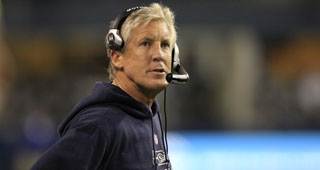
Coaching: Pete Carroll enters his third year at the helm in Seattle, and this year his staff remained largely intact. Carroll comes from the college environment where every position was open for competition in every practice, a system that produced champions at USC but has yet to translate in the NFL. Not all NFL players want that kind of job challenge, but Carroll has had enough time to bring in his own kind of players. This is the year it will either pay dividends or seal his fate. Darrell Bevell continues to milk Brett Favre’s renaissance in Minnesota, the only year where his offenses have been above average, at Offensive Coordinator. OL Coach Tom Cable made a difference under duress in his first year, and Defensive Coordinator Gus Bradley is known for being a good teacher of fundamentals. Most of the positional and assistant coaches are entering their second years in the program, which should help with familiarity.
Breakout player: Russell Okung. If he can stay healthy, this is the year Okung shows everyone why he was a top 10 overall pick at left tackle. He has all the physical tools and the desire to be great.
Forecast: The schedule makers did the Seahawks no favors, with four cross-country games in the Eastern Time Zone. The record for Pacific Time zone teams heading east is not pretty. The month of October is likely to reveal the true colors and playoff fate of the Seahawks, a rough four-game stretch that features three road games (CAR, SF, DET) and a home matchup with the Patriots. Not only are those four good teams, they are four very different styles of team, which makes it hard to carry momentum and keep cohesive game plans in place. If they can survive the early tests--something they could not do a year ago--the late season schedule is primed for a run that could extend into the playoffs. I like the Seahawks to muddle through early and surge late, finishing 10-6 and winning the NFC West in a surprise. I like them even more if Wilson is the starting quarterback.
[email protected] or Twitter @JeffRisdon