RealGM Analysis
2011 Record:
Point Differential: -23
Turnover Margin: +1
Sack Differential: -4
Offense:
2011 Ranks
Rushing: 3rd
Passing: 13th
3rd Down: 10th
Scoring: 5th
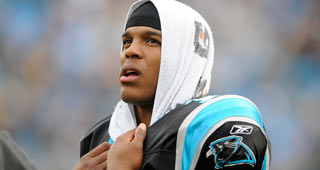
QB: Cam Newton exceeded all expectations in his rookie season, even those of his more ardent pre-draft supporters, of which I was a torch bearing member. Newton proved that the creative athleticism he displayed in his glorious year at Auburn absolutely translated to the NFL. Where he unexpectedly thrived was as a passer, demonstrating better touch, better vision, and a willingness to stand tall in the pocket than anyone imagined. No, he was not without faults; Newton’s yards per attempt regressed (other than laughers against hapless Tampa Bay) as the season progressed, he took too many sacks, and tried force-feeding Steve Smith a little too frequently.
The question is, where can he go from here? No rookie has ever done anything close to what he did in throwing for over 4000 yards, rushing for over 700 yards and a QB-record 14 TDs, completing 60% of his passes and a 21/17 TD/INT ratio. He accomplished that despite fewer than 15 starts at the major college level and a limited offseason to get to speed thanks to the lockout. There is a very real temptation to extrapolate what Newton did last year and predict seemingly absurd progress, to the tune of 5,000 yards, 30+ TDs, 800+ rushing yards, and legit MVP candidate status. That is plausible, but it’s more likely the defenses of the league catch up with him a bit, as they did later in that great rookie year. I don’t think he’ll score double digit rushing TDs again, although I still believe Newton will be the preeminent 3rd and short converter in the league (10 for 10 last year with his legs). And I will be surprised if Newton isn’t in the top five offensive players in MVP voting at the end of any of the next eight seasons, so long as he stays healthy.
Derek Anderson returns as the backup. He knows OC Rob Chudzinski’s system from their days together with Cleveland, days that Browns fans would prefer never happened. Anderson has a great arm and can catch fire at times, but his accuracy is wildly hit and miss and he struggles to avoid pressure. DA understands and embraces his role here, and the Panthers seem comfortable relying on him for a series or two should Newton’s risky style of play send him to the sidelines for a bit. But if Anderson has to play more than half a game, the Panthers are unlikely to win that game.
My how Jimmy Clausen has fallen. The onetime golden boy at Notre Dame by way of SoCal was once widely regarded as a top 10 pick. He fell to the 2nd round in 2010, and then proved why as he turned in one of the worst QB seasons in recorded history. Granted he got little help from a team collapsing around him, but he failed to endear himself to anyone and will remain chained to the bench here…if he even makes the team. The Panthers could opt to go with just two QBs, and it would be cheaper to cut Clausen now than at points next year.
RB: One of the most impressive things about the stocked stable of runners Carolina has fielded for the past few years is that you never hear anyone complaining about their roles. DeAngelo Williams, Jonathan Stewart, and even Mike Tolbert are all worthy NFL starters, yet the Panthers somehow keep everyone happy. Last year, Williams and Stewart both had statistically down years in terms of total yards, but the team had three players (those two and Newton) rush for more than 700 yards and all three averaged better than five yards per carry.
Williams is the speed back, a home run hitter with amazing breakaway burst and north/south acceleration through (or around) the hole. He has more TD runs of 25 or more yards than any player over the last four seasons. Williams is lightning outside the tackles, capable of turning any pitch or toss sweep into a gamebreaking TD. Short but not small, Williams is also a pretty solid receiver and won’t get Newton killed in pass protect.
Stewart is built like a power back with thick legs and a prominent posterior, but he is surprisingly light on his feet and can break runs outside. His rushing role has steadily diminished but not because of ineffectiveness; 2011 was arguably his best season, putting up 5.4 yards per carry and losing yards just twice. Stewart is an exceptional receiver with very soft hands, and Newton found him 47 times a year after Stewart caught just eight. That’s the value of versatility, and it really keeps safeties and outside backers honest. He thrived taking handoffs deep out of the shotgun, which often allowed the penetrating tackles to run right past him. I wouldn’t expect more than 750 yards rushing again (barring injury to Williams), but he could get back above five TDs and could threaten 500 yards receiving.
Tolbert replaces unreliable speed demon Mike Goodson, and he’s more of a hybrid FB/RB. Built like Reginald Veljohnson (aka Uncle Carl on Family Matters), Tolbert doesn’t have much speed and often runs up the back of his blockers, but he has tremendous lower body power and his legs never stop moving. That gives Tolbert the upper hand with leverage and allowing him to snowplow for positive yardage. To keep playing the broken record, Tolbert is also an excellent receiver out of the backfield and very good in pass protection. How the Panthers use him will be interesting, as he wasn’t very good at being a blocking back with San Diego and Coach Rivera saw that firsthand. He took less money to rejoin Rivera, so it presumes Tolbert is cool with whatever his role will be.
WR/TE: The renaissance of Steve Smith with Cam Newton throwing the ball is a true testament to the impact on WRs of having a QB they trust and respect. That’s especially true of Smith, a noted truculent soul who made a conscious choice to buy into Newton and Chudzinski. Carolina is very thankful he did, because he produced a monster rebound season: 79 receptions (from 46), 1394 yards (from 554) and seven TDs (from two). What stands out is the yards per catch figure, 17.6. That’s a huge number for a 5’9” 32-year-old and a figure he’s topped just once before. Smith is an emotional powder keg, and as long as the Panthers can focus and focus that volatility into production, they have themselves one of the top receiving threats in the league. It bears watching how Smith would handle only seeing 15 throws through the first four games, if that happens.
Brandon LaFell brings size and strength to the other side, and there is fervent hope in Charlotte that his strong finish last year is a harbinger of greater things to come. After taking over for Legedu Naanee (now with the Dolphins) in the starting lienup, LaFell looked much more confident and in command of the offense. He needed it, because before about Week 10 last year his first two seasons were largely disappointing. LaFell flashed the big-play ability (see Tampa Bay game) and got open more consistently in the 10-to-15 yard range. He’s neither exceptionally quick nor fast, relying more on his size and precision to get free.
LaFell's old role of #3 wideout figures to go to recent acquisition Louis Murphy. The former Raider is essentially a less bulky LaFell, a guy with just enough speed to be dangerous but more about body control and using his length. Look for Murphy to be the deeper threat but catch fewer balls, and he must learn to play better through minor injuries.
Speaking of injuries, David Gettis will try to recover from those and take the field after missing all of last year. He was ahead of draftmate LaFell as rookies in 2010, and he played collegiately with Robert Griffin III at Baylor so adjusting to Newton’s style shouldn’t be too difficult. Gettis has yet to be cleared for practice (it’s Aug. 14th), however, so any contribution this year must be considered gravy. Depth beyond includes Kealoha Pilares, a speedy slot-type who played special teams as a rookie out of Hawaii last year, rookie Joe Adams, who figures much more prominently as a return specialist, wasted draft pick/former App State QB Armanti Edwards and big Seyi Ajirotutu, once a favorite sleeper of this draftnik and the most likely to click with Newton. Edwards will stick only if he offers Wildcat versatility, but on a team with Newton at QB that seems kind of pointless.
The Panthers have a pair of receiving tight ends that help blunt the effect of not having much exciting talent at wide receiver. Greg Olsen pulled down 45 passes in his first year after fleeing Chicago. He makes his living in the danger zone between linebackers and safeties down the seams, and Olsen is generally reliable at plucking the ball and absorbing contact. His blocking is much improved from his early days when one notable Chicago radio personality repeatedly referred to him as “Turnstile”. Nobody will ever confuse him for a brawler like Jeremy Shockey, however. The big country boy is on the downside of his strangely loud career, but he remains an effective target and one of the most physical blockers in the league. Shockey thrives on attention and does a fine job taking the brunt of negative energy for his team, an underappreciated asset for a team with a rookie coach and QB. He might not catch even 30 balls this year but expect the Panthers to continue using him extensively in “12” personnel (1 RB, 2 TE) with Olsen because he still commands defensive respect. As long as Newton keeps him happy, Shockey can be a great leader, but if things turn Shockey can get ugly, quickly. Gary Barnridge and Ben Hartsock will battle for the #3 spot. Both have experience but don’t offer much more than competent relief for a drive or two.
OL: I had a wonderful chicken vs. egg argument during Senior Bowl week in Mobile with a scout from a NFC South opponent about how much the Panthers OL really improved, and how much of that was attributable to Cam Newton. I was the chicken; I believe Byron Bell at right tackle grew up quickly, and Geoff Hangartner at RG was much better in pass protection than Geoff Schwartz the year prior. While I acknowledge Newton’s size and escapability certainly helped, I thought the line played better and that includes stalwart LT Jordan Gross, who was down a bit in 2010.
The scout countered that Bell was not up to Jeff Otah’s one-time standard at right tackle, even though Otah has hardly played this decade. He felt Ryan Kalil wasn’t as sharp at center, a point which I vehemently disagree. He also felt that the guards (Hangartner and Travelle Wharton) lost momentum as the year progressed.
Wharton and Otah, once prized assets, are both gone now; Wharton is fighting for the left guard job in Cincinnati, while Otah was traded to the Jets only to fail a physical and subsequently get released. Those two, when healthy, were among the very best run blockers at their positions in the league. The Panthers are very optimistic rookie Amini Silatolu will fill some of that void at left guard. He is massive, he is supremely athletic, he is nasty, and he is most definitely a work in progress. Silatolu is a 2nd round pick from Midwestern State, a low level of competition where he often dominated just by standing up. Early camp reports are that he’s legit as a run blocker but his pass protection is a little greener than expected. To continue the poultry discussion with my scouting friend, I suggest that Newton will help Silatolu look better more than the inverse. See, I can concede points in an argument; I guess that’s why I’m not a politician…
To address depth, the Panthers brought in former Raider Bruce Campbell to be the #3 tackle. An athletic freak with very long arms, Campbell was a major project that never fully developed in his two years in Oakland. Free agent Mike Pollak, a weak link on a terrible Colts line, figures to be the top interior reserve, along with underwhelming holdover Bryant Browning. If you’re looking for a potential catastrophe with the Panthers, it’s any injury to starters on the offensive line.
Defense:
2011 Ranks
Rushing: 25th
Passing: 24th
3rd Down: 26th
Scoring: 27th
DL: This was a weak point a year ago, but the Panthers are relying on internal improvement rather than seeking outside help. That is especially true inside, where Sione Fua and Terrell McClain both started as third-round rookies last year. McClain flashed talent on the occasional play, and he has some upside as an interior rusher. He has good quickness and tries hard, but he must learn to shed blocks and flow outside a one-yard radius to make plays. Fua is an anchor/nose type tackle, but he routinely got beat to the point of attack off the snap and showed even less ability to keep blockers at bay. It didn’t help that they had nobody else to play that clogger position, but Carolina is fervently hopeful that Ron Edwards is fully recovered from a torn triceps that kept him out all of last year. He was a prime free agent target, coming from Kansas City where he played the nose. Edwards is not much of a playmaker and at 33 coming off injury is no sure thing, but if he and Fua can rotate and stay fresh they should help remedy the 5 yards per carry up the gut the team surrendered last year.
Andre Neblett spells McClain and got some starts once the latter went down with an injury late in the year. He’s shorter but also a little quicker off the snap, and he was responsible for nearly all the interior line’s plays in the backfield. That’s all there is, folks. Perennial practice squad/waiver wire fodder Ogemdi Nwagbuo just killed my spell checker, and that represents the most disruptive thing he’s ever done in football.
Things are a little better at end, where Charles Johnson followed up his phenomenal 2010 with a solid ’11 campaign after signing a huge contract extension. His 9 sacks were down from 11.5 and he had a handful fewer QB pressures, but given the utter despair inside Johnson gets a pass. Johnson actually made more plays behind the line against the run and was more active pursuing plays from the back side, showing a more complete game that bodes well going forward. Those 9 sacks were more than double the next in line, fellow starting DE Greg Hardy. Nearly all of Hardy’s noteworthy play came early in the season, as he had just one sack and two QB hurries after Week 8. Conditioning was an issue but not having anyone to get him off the field or even take practice reps completely spent Hardy out. For a guy noted for being somewhat apathetic at Ole Miss, Hardy’s progress early on and positive demeanor even while struggling late is a very positive sign. He has looked good in camp according to observers I trust, with better bulk and more engaged with his teammates.
They did get a little help at end in the draft in the form of Frank Alexander, a pass rush specialist from Oklahoma. He has some functional power and plays with a relentless motor, though Alexander lacks great quickness or closing burst. He’s more of a guy that will generate pressures and disrupt throwing lanes, which are both necessary upgrades but not the kind of impact that will make this pass rush a whole lot more effective. He could earn more reps with stoutness against the run. Converted LB Antwan Applewhite had a handful of good moments after arriving in Week 5, but he really struggled at the point of attack and has no real pass rush moves. He’s a classic DE/LB tweener, though he knows Rivera’s system from their time together in San Diego. Intriguing youngster Thomas Keiser brought a little spark off the practice squad late in the year, and he will be given the chance to earn a more regular spot in the rotation this summer.
LB: It’s all about health, with two starters coming back from knee injuries suffered before the end of Week One last year. Jon Beason and Thomas Davis both blew out knees early, causing a serious shuffling and devastating the defense. Beason will be back in the middle, but expecting anything from Davis is a huge mistake. The swift Davis has blown out his ACL three times, and his game is totally predicated on speed and agility. He was once an above average all-around talent at the weakside spot, but sadly I believe those days are gone. The Panthers are clearly playing it safe with Davis; expect him to be a situational sub on passing downs, not a full-time player.
Fortunately for Panthers fans, the team drafted Luke Kuechly in the first round. The Boston College product is exactly what Carolina needed at the second level: freakishly instinctive, strong in coverage, a sure tackler with textbook fundamentals. He’s not exceptionally fast or big, but he dominated at the college level by knowing every play the offense was going to run as soon as the ball was snapped. He reminds me of my football hero, Chris Speilman, another player that combined merely decent physical skills with unmatched preparation and innate instincts that allowed him to thrive for over a decade in the NFL. I expect nothing less from Kuechly, who can play in the middle or outside, and everything I’ve heard from training camp is that Kuechly is better than expected already. One longtime Panthers observer told me, “(Kuechly) is the best cover backer we’ve ever had here”. That was after two weeks of training camp and this is someone who has been around the team since its inception. Expect Kuechly to start outside but move inside should anything happen to Beason again.
Another former first round pick (in 2007), Beason has been a tackling machine for Carolina. Beason has averaged 125 tackles a year in his four full seasons, with at least 100 solo tackles in three of those four campaigns. Undersized but not small in a football sense, Beason is also quite instinctive and closes to the ball with controlled aggression. He seldom overruns plays or gets caught out of position. If he is even 90% of his old self, the Panthers will be happy.
James Anderson figures to get the nod ahead of Davis after more than capably filling his shoes the last two seasons. While he didn’t make many big plays a year ago (1.5 sacks, 2 INTs compared to 4 sacks, 1 INT & 2 FF in ’10), only London Fletcher and Chad Greenway have more tackles over the last two seasons than Anderson’s 275. If he could make more of those tackles closer to the line of scrimmage, the Panthers would be even happier. Anderson has essentially been a garbage man, running down ball carriers that got past the anemic front about five yards down field. He lacks strength to stack the play and he’s only average in coverage. If Kuechly and Beason both have the kinds of season they should, Anderson will rack up a lot fewer tackles but has the potential to make them more important ones. He has always had a knack for timing blitzes going back to his days at Virginia Tech.
Beyond Davis, the depth is pretty thin after Jordan Senn, who looked like a legit NFL linebacker once he got up to speed last year. The undersized Senn (5’11”, 225) has trouble avoiding blocks but hits with authority and learned along the way. He registered double-digit tackles in each of the final three games, although like Anderson nearly all were of the downfield cleanup variety. Jason Phillips has big shoes to fill replacing Dan Connor, who parlayed relative competence replacing Beason into a free agent deal with Phillips’ old team, the Cowboys. Another Cowboys castoff, Jason Williams, will back up outside but primarily play special teams. He and Kion Wilson will fight for that right in camp. Eric Norwood will have to really impress this summer to keep his roster spot.
Secondary: All four starters return, but three of them will need to play significantly better if they want to keep those jobs long term. The exception to that statement is corner Chris Gamble, who comes off a spectacular 2011. Gamble really clicked with the new coaching staff after clashing with the old John Fox regime, and he turned in a great performance. He has great length and understands how to use his body to steer the receiver, an underrated attribute in a division with so many big wideouts. Gamble is aggressive against the run, though he doesn’t always finish what he starts there.
The other starting corner is gritty Captain Munnerlyn, but he must play better. Ideally he is a slot corner, where he was decent when the Panthers had a better starting option in front of him. Small and tough but not technically sound with his footwork or blessed with great speed, Munnerlyn often found himself overmatched by receivers that were either really big or really fast. You could see that it negatively impacted his tackling, where he had a nasty tendency to put his head down and lunge. The fervent hope is that 5th round rookie Josh Norman can get up to speed quickly and push Munnerlyn back to the inside nickel role. Norman certainly has the potential to do that, but it’s asking too much for him to make the jump from Coastal Carolina to Carolina in 9 months. He has great length and fast-twitch muscle and showed during Shrine Game week he can handle himself well in coverage, but a hamstring injury has slowed his camp. Look for him to struggle early but play well enough late in the year to wind up starting in 2013. That leaves the passive Darius Butler and seldom used ’11 4th rounder Brandon Hogan as the best options to fill in against multiple wideout formations. Hogan did play well in the finale last year and has good aggression, so there is some hope he can break out in his second year. He’s probably a safer bet to contribute more than Norman in 2012.
The safety play was nothing short of awful last year, but Sherrod Martin and Charles Godfrey amazingly held onto their starting roles. At free safety Martin really struggled to keep plays in front of him. He lacks the instinctiveness to sniff out plays and he also lacks the great closing burst to finish the plays. His tackling was subpar as well. Martin has been better in the past and was perhaps trying to do too much. He was at his best when locked up in man coverage. I don’t expect him to be so bad again, but he needs to dramatically improve if he wants to keep his job. Godfrey was better at tackling but also lacked range in the passing game. He fared well in coverage closer to the line but is not reliable for over-the-top or sideline help.
Free agent Haruki Nakamura could push for a starting job. In Baltimore he was much more prodigious on special teams, but Nakamura packs a big punch in his hits and has better closing burst than either returning starter. The Panthers are hoping some Ed Reed rubbed off on him, and he has impressed early in camp. Reggie Smith also comes via free agency after spending the past few years as the #4 safety in San Francisco. He’s more of a big corner than a safety and it shows in run support. Smith could fill the role of heavy nickel back if he clicks with the new defense; I liked Smith coming out of Oklahoma in that role. That’s in an ideal world, however, and it’s more likely Smith changed uniforms but kept the same spot on the depth chart. Holdover Jordan Pugh is also in the mix, as is Jonathan Nelson. May the better special teamer win!
Special Teams: These units should be better in 2012. Olindo Mare ranked near the bottom in FG% in 2011 and had the shortest “long” FG of any regular kicker in the league in 3 years at just 45 yards. At least he still boomed kickoffs like he always does, which provides legit hope that the field goal accuracy and length can return. He will get a real test from Justin Medlock in camp, however. There is also a camp battle at punter between longtime Lions leg Nick Harris and Wisconsin rookie Brad Nortman. The team used a 6th round pick on Nortman and that means something, so look for youth to prevail. And in the spirit of competition, the punt return job is up for grabs in a battle royale between Armanti Edwards, Joe Adams, and Kealoha Pilares. Edwards ranked dead last among regular punt returners a year ago and he must blow the competition away to keep his roster spot here. Pilares showd some spark on kick returns a year ago, though if he is forced into more duty on offense it’s asking too much to give him both return gigs. Adams was open field dynamite at Arkansas and with a strong preseason showing he could run away with both jobs. Adding Nakamura should help the return units, but they’ll also get a big bolster from having regulars like Jordan Senn and Jordan Pugh focused more on their ST duties and less involved in the base defense.
Coaching: Ron Rivera handled his rookie coaching test pretty well, albeit under the burden of zero expectations. Now there is playoff talk (thanks Ryan Kalil!) and Rivera must prove he can help the team make that jump. He’s got the right mentality to handle the task, and the players uniformly like and respect him. Look for more creativity from DC Sean McDermott, a Jim Johnson disciple who played ER doctor more than strategist in his first year. OC Rob Chudzinski’s past experience is punctuated by wild fluctuations, and he’s on the spot if Newton doesn’t somehow improve upon his masterful rookie campaign. He did a smart job tailoring the offense to what suits Newton, but now that defenses have that on tape he must make the proper adjustments and pull more rabbits out of hats. Strength coach Joe “House” Kenn has a big task keeping a host of players with high injury risk on the field. As House is someone who would rip off my arms and beat me over the head with them, I’ll give him the fearful benefit of the doubt he will be awesome at it.
Breakout player: Luke Kuechly. Of course a first round pick should impress, but Kuechly is my choice for Defensive Rookie of the Year. Rare is the rookie linebacker that can play on all three downs and make an impact against both the run and pass. Kuechly is a special talent and will shine right away.
Forecast: Last year this team went 6-10 despite a dreadful defense and poor special teams. Both of those will be improved in 2012, and the offense remains potent. Even with a sophomore slump from Cam Newton, Carolina can lean on a strong running game to get offensive production. A healthy linebacking corps and better pass rush should vault the defense into the top 20, and as long as the turnover margin is even or better, that will be enough to push this team into the playoffs. That’s right, playoffs. To achieve that they will need a couple of key victories in the middle of the schedule: Week 4 at Atlanta, Week 5 vs. Seattle, Week 7 hosting Dallas, and Week 8 at Chicago. Win three out of four--which is eminently possible--and Carolina will earn a playoff berth. Lose 3 of four and it’s going to be an 8-8 finish at best. I think they ride the magic of MVP candidate Cam Newton to a 10-6 record and sneak into the playoffs in a very crowded NFC race.
[email protected] or Twitter @JeffRisdon
Jeff Risdon is RealGM's senior football writer.
Follow @JeffRisdon on Twitter.