RealGM Analysis
2011 Record
Point Differential: +103
Turnover Margin: +7
Sack Differential: +11
Offense
2011 Ranks
Rushing: 2nd
Passing: 18th
3rd Down: 7th
Scoring: 10th
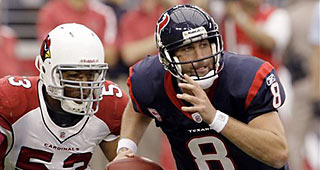
QB: Before his injury midway through last season, Matt Schaub had finally emerged as the unquestioned franchise quarterback the Texans expected when they traded for him several years ago. Inconsistency and untimely turnovers had always marred his tenure, but last year he appeared to have put all that behind him. His accuracy was improved, his confidence better, and his decision making more savvy. But the injury bug that often bit him early in his Houston days bit hard, forcing a Lisfranc surgery that makes his durability and viability a bit of a question in 2012. The Texans are concerned enough about it that Schaub is playing out his contract year and the team will not give him an extension until he proves himself. Consider that a fair warning that Schaub, who as of this writing has yet to participate in live drills, might not be the same guy again.
Should Schaub not be able to fully recover, the job falls to second-year T.J. Yates. The third-stringer generally acquitted himself well in emergency duty as a rookie, showing a good grasp of the offense and excellent touch. But he lacks the big arm and tended to make poor decisions when pressured or rushed. While that is true of every rookie to some extent, Yates particularly seemed to struggle when the coverage was not obvious or the rush came from unexpected places. Still, he won a playoff game and engineered a game-winning drive that clinched the first-ever playoff berth and his teammates and coaches all trust in him and have confidence he can do it again. John Beck and undrafted rookie/University of Houston hero Case Keenum will battle for the No. 3 job, which Yates held until halfway through last season. The smart money is on Keenum even though he lacks arm strength.
RB: There might not be a better 1-2 tandem in the league than Arian Foster and Ben Tate. Foster can rightly claim the title of best running back in the league. There is very little Foster does not do quite well. He can run inside or outside, depending on the hole. His vision and burst are excellent. Foster runs with good pad level, balance, and leg drive, which allows him to absorb contact and break tackles better than most runners. He has very soft hands out of the backfield and can lay out a blitzing linebacker if needed (see: James Harrison). Foster is also a free-spirited, pensive, provocative individual that sees the big picture and is genuinely interesting and fun to be around. With Schaub and Andre Johnson not being much in the way of outward leadership presences, Foster fills an important void there for this team that cannot be overstated.
Tate impressed in his first season after losing his rookie campaign to an injury. He runs high but hard, with sneaky shiftiness and good power. The coaches liked how quickly he picked up the entire offensive system and his willing attitude to do his part-time role. But when Foster was out with a gimpy hamstring, Tate exploded and proved he could easily be a feature back in his own right. Tate very nearly topped 1000 yards even though he got just 175 carries and missed one game. He is not as versatile as Foster, not as good as a receiver and has some fumbling issues.
Third string back Derrick Ward retired, which leaves that position to Seahawks castoff Justin Forsett. The Cal product is more of a third down back in the mold that Texans fans recall Steve Slaton, and as he nearly did in Seattle last year, Forsett could get more yards receiving than rushing. James Casey is the starting fullback but he is a pure hybrid, a converted tight end that is in pre-snap motion almost every play. The Rice graduate will likely not register a single carry but could pull down 25+ passes. For a more thumping lead blocking presence, the Texans brought back Moran Norris. He began his career in Houston a decade ago and the Houston native still has some limited value as a blocker. He will have to, because roster spots are precious and Norris has touched the ball just 66 times in his 10-year career.
WR/TE: There is Andre Johnson, there is Kevin Walter, and there are inexperienced question marks. Johnson remains a very good No. 1 receiver with excellent size, strength, and body control. Yet he is coming off a season where he played just seven games and scored only two touchdowns, looking less explosive and a little worn down even before the hamstring injury forced him out. Years of being the only real threat in the passing game could be taking their toll on Johnson, who is now 30 and with a lot of miles on his body. He is still the best wideout in Houston and will undoubtedly put up about 90 receptions for about 1150 yards and a handful of touchdowns, but if you are a fantasy geek do not get too confident in a return to elite status.
Walter gets very little publicity but is quietly a pretty effective possession receiver. He has deceptive size and strength, a good catch radius, and enough shiftiness to get himself open. Like Johnson, he is a very good blocker. Walter is coming off a down year, however, and like Johnson he is on the wrong side of 30. He has never been much of a threat after the catch, and with Johnson not the downfield flyer he once was, the Texans need someone who can create after the catch and stretch the field.
Jacoby Jones held that role the past few years, but his maddening inconsistency and lack of attention to detail punched his ticket out of town. Three youngsters are vying to take over his role: Lestar Jean, Devier Posey, and Keshawn Martin. Jean was the star of 2011 training camp before getting hurt. Blessed with the same sort of athletic style as Jones -- big, lanky, fast, long-striding -- Jean showed good coordination and an extra burst gear to get open deep. But that was training camp, and he must prove he can get on the field and do it in live action. Posey was a third round pick, coming off a star-crossed career at Ohio State. At times a dynamic midrange threat with a flair for the dramatic, at times frustratingly sluggish and prone to lazy routes and hands, Posey is an unpredictable talent. If the coaches can reach him, they have a play-making gem. Another rookie, fourth round pick Martin comes from Michigan State with smoothness as his calling card. He is on the small side at just under six feet tall, but he is very nifty with his feet and runs with a deceptive effortlessness and sharpness. If Martin can catch the ball cleanly and master the route tree, he should see lots of time as the slot receiver. Martin also inherits the role of Jones as the punt return man as well.
The Texans use the tight ends quite a bit, particularly in the red zone, and they have a good one in Owen Daniels. He was the leading receiver in 2011 and looked very well recovered from a blown out knee. Daniels has a strong first step and is very good between the hashes between the safeties and linebackers in the zone. But the No. 2 spot is open after Joel Dreessen took his 6 touchdown catches to Denver. Garrett Graham, like Daniels a Wisconsin product, has just one reception in two years and does not have the size or leaping ability of Dreessen. Undrafted rookie Philip Supernaw has a lot of athletic tools but must make the jump from Ouachita Baptist. Find that on a map...
OL: Major changes abound up front, with two new starters replacing quality stalwarts. This is the biggest question mark on the entire team. The Texans brass has been quietly but stridently confident that right tackle Eric Winston and right guard Mike Brisiel will be capably replaced by Antoine Caldwell and Rashad Butler, respectively.
Butler is on the spot at right tackle. He has played pretty well when given the chance, but Winston had a much greater value to the team than just being a very good right tackle. He was the unofficial team spokesman, offensive leader, and conduit between the coaches and players. Butler will not be able to fill that void no matter what he does on the field. It does not help matters that Butler missed almost all of last season.
The Texans consciously chose to keep center Chris Myers over Winston, and in terms of on-field performance it is a hard decision to argue against. Myers is a very solid veteran that seldom gets beat or makes mistakes on line calls and adjustments. He is ideally skilled to run the zone blocking scheme used in Houston, quick with both his hands and feet. Left guard Wade Smith is not flashy but reliably gets the job done. He was visible well downfield on several of the longer runs of Foster. Left tackle Duane Brown has grown into his own as a very good all-around blocker. Many felt he deserved a Pro Bowl nod for his performance last year, and with 2012 being a contract year expect more of the same, if not even better.
All the depth is young. Two rookies, Ben Jones and Brandon Brooks, will be the primary interior reserves. Third round pick Brooks could outright win the starting right guard job with a strong summer, and his sheer massiveness at 335+ pounds would make him a much bigger addition than any of his mates. Second year man Derek Newton is the No. 3 tackle after impressing during last offseason. There is good potential here but the inexperience is glaring.
Defense
2011 Ranks
Rushing: 4th
Passing: 3rd
3rd Down: 13th
Scoring: 4th
DL: When the Texans drafted JJ Watt #9 overall in 2011, it raised some eyebrows. But from the first few weeks when Watt arrived, the entire tone of the defense changed. The immediate starter at RDE in new 3-4 scheme of defensive coordinator Wade Philips, his relentless brute strength and motor set a positive tone for the entire unit. Watt has a strong bull rush but also has surprisingly quick shoulders and hips that allow him to get off blocks and through gaps. His athleticism was never on better display than his INT/TD in the playoff win over Cincinnati. Watt is going to be a very good player in this league for a long time.
Veteran Antonio Smith handles the left end spot, and the more I watched of Smith the more I appreciated his game. He has a strong punch and very active feet, but what shows up time and again is his mastery of angles. Smith is almost always the player dictating the angle of contact and that gives him the advantage of leverage and balance. He is quick enough to work off that and make moves to get to the QB or the ball carrier. His 6.5 sacks bested Watt by one, and that ability to bring pressure from the front on both sides really freed things up for the outside backers and made life miserable for opposing offensive line coaches.
Nose tackle was the relative weak spot, though Shaun Cody had arguably the best year of his NFL career. Cody has very good strength even though he lacks the bulk of a traditional nose, and he does a fair job of getting in the way of the hole. The coaches have gone out of their way to praise his effort, but they are also keen on Earl Mitchell. Expect the two to rotate the spot and also play together when the team uses a 5-2 alignment, which they deploy more frequently than most teams.
Depth at end got a boost from the draft with fourth round pick Jared Crick. Before injuries scuttled his Nebraska career, Crick was regarded as a first round talent. If he can get close to his old self, he will make a strong complement to Watt and eventually take over for Smith. Plugger Tim Jamison does not look pretty but gets the job done when given chances. Rookie Rennie Moore will have to impress in camp to get beyond the practice squad.
LB: Longtime leader Demeco Ryans did not fit into the 3-4 defense and was dispatched to Philadelphia. The loss on the field will be minimal, but Ryans carried a lot of weight in the locker room and film room, and that will be tougher to replace. But on the field, newcomer Bradie James represents an upgrade for this defense. He has run the Wade Philips defense for years in Dallas and still has decent range to go with his instincts. The Cowboys did not appreciate all he brought to the table, and his addition should help in the locker room as well.
James will start next to Brian Cushing, who took to the new scheme well. Cushing has excellent size and power, and being inside in the 3-4 allows him to focus more on using his freakish strength inside the B gaps, taking away his biggest liability, his lateral range. He is a strong fundamental tackler as well as being a thumping hitter, and Cushing also showed he can blitz nicely. By the end of the season Cushing was playing as well as any 3-4 ILB in the league not named Patrick Willis. Darryl Sharpton outplayed Ryans last year and is the best cover backer on the team. Tim Dobbins should stick as the other reserve.
The outside backer position will also look different as Mario Williams left in free agency for a massive payday in Buffalo. It is hard to say the Texans will not miss the former #1 overall draft pick and team leader in sacks, but the Texans got very good production a year ago from the tandem of Connor Barwin and Brooks Reed. Adding first round pick Whitney Mercilus to the rotation gives the team very strong potential depth and speed to rush the passer. Barwin bounced back from a gruesome leg injury to bag 11.5 sacks, including nine after Williams went down with injury in Week 5. That figure led the league over that time frame. Barwin has a great motor to go with his strong legs and arms, and he has surprisingly polished pass rush moves for a guy that was a tight end just four years ago. He is playing for a new contract, so expect a repeat sack total, at minimum, if Barwin can stay healthy. He and Watt forged a fast friendship and have emerged as the leaders of the "Bulls on Parade" defense and are fan favorites around Houston.
Reed proved this draftnik wrong with a strong rookie season. What genuinely stunned me was how well Reed played against the run, but he quickly grasped how to set an edge and shed the block to get to the tackle. His speed rush around the edge is what got him drafted in the second round, and Reed consistently flashed that ability as well. With the similarly speedy Mercilus spelling the starters in rotation, the Texans can bring pressure off both edges in fresh waves of energy. Unheralded Bryan Braman showed tremendous energy and fearlessness on special teams and limited reps during his rookie year. He will back up Reed on the strong side and has intriguing potential. Veteran Jesse Nading will have to step up his game to stay in Houston, particularly if hard-hitting UDFA Shawn Loiseau continues to impress.
Secondary: This unit has long been an abused laughingstock, consistently rating in the bottom five of pretty much every statistical metric used to evaluate pass defenses. But two new additions and a position change for a young holdover made all the difference in the world. Now the Texans have a very solid back end that could still improve.
The new additions, safety Danieal Manning and corner Johnathan Joseph, did not come cheap but were worth every penny. Manning brought range, positional integrity, and sound tackling to a position that only sporadically had any of those qualities. Joseph was arguably the best cover man in the entire AFC, a perfect fit in the defense and a revelation for Texans fans about how a talented corner can take away an opposing wideout. Their presences also brought about a more proper reordering of the depth chart, a trickle-down effect that positively impacted the entire defense.
With Manning upgrading free safety, Glover Quin moved from being a marginal nickel corner to a surprisingly adept strong safety. He has decent size, but his lateral quickness and willingness to hit made the transformation an unabashed success. Quin used his corner cover skills to handle receivers across the middle, something that the Texans have never had before. With the great range of Manning and quickness on the other side, it made for a radical change that should continue to thrive.
Joseph at corner helped cover a lot of ills, but there is still a need for a second corner to step forward. Brice McCain improved quite a bit, but he had to in order to be merely adequate as the nickel corner. McCain got picked on a lot, and he responded by showing good ball skills and better spatial awareness. He is still not a great tackler and can get paralyzed when multiple receivers are in his vision, but sliding him inside and simplifying his role is a good concept. It is now or never time for former first round pick Kareem Jackson, who has been largely awful in his first two seasons. Jackson simply cannot turn and run with most NFL receivers, and his jam is sporadic. He did show some improvement as 2011 bore on, better using his length and anticipating routes. He is no longer in danger of being a high-profile training camp cut, but the team needs him to prove he can be a functional No. 2 corner and he has yet to confirm that ability.
Newcomer Alan Ball will compete with two 2011 draft picks, Brandon Harris and Roc Carmichael, for the depth corner jobs. The experience of Ball in Dallas gives him the leg up, as neither Harris nor Carmichael showed much as rookies. Carmichael is a roster long-shot at this point. Troy Nolan is the No. 3 safety and a pretty good one in run support. The team is comfortable with him spelling either starter for a series or two. Shiloh Keo and Quentin Demps fill more of a role on special teams than at safety and one of them (likely Keo) could be the victim of a numbers game. The Texans even have a couple of somewhat promising UDFAs in camp in Desmond Marrow and Torii Williams that can probably make some NFL rosters.
Special Teams: There will be camp battles for both the punting and kicking jobs. Houston will definitely have a new kicker, as Neil Rackers will be replaced by either veteran Shayne Graham or rookie Randy Bullock, their sixth round pick from Texas A&M. Look for Bullock to win but he will have to earn it. Punter Brett Hartmann really hurt his chances by getting suspended for PEDs, causing him to miss the first three games. He is also coming off a torn ACL. Veteran Donnie Jones could be more than just an insurance policy and placeholder until the suspension of Hartmann ends. Houston will also have a new return man. Tiny Trindon Holiday will fight against Keshawn Martin and depth RBs Justin Forsett and Davin Meggett.
Coaching: Gary Kubiak earned his contract extension with the first-ever playoff berth for the Texans and a division title. Understated publicly but more fiery than expected behind closed doors, Kubiak is a consistent force for an ever-changing team. His choice of Wade Philips to overhaul the defense was an inspired gamble, and both Philips and DB coach Vance Joseph deserve huge kudos for their work. All primary coaches return, as does the front office led by GM Rick Smith. Continuity and security will not breed overconfidence here.
Breakout player: Rashad Butler. The new right tackle is under the gun in replacing wildly popular team stalwart Eric Winston, but I believe Butler will be up to the challenge. There should be little noticeable drop-off as Butler handles his business and proves the Texans were right to keep Myers at Winston’s expense.
Forecast: Following up the most successful season in team history is never an easy task for any franchise. Several team leaders moved on, and there are legit questions at quarterback and on special teams. But the Texans still have loads of talent. They also harbor a sense of a mission unfulfilled even with the playoff success. The young, hungry defense should thrive, and the Arian Foster/Ben Tate duo is ideal for salting away leads. The early schedule is favorable; it will be a disappointment if Houston hits the Week 7 rematch with the Ravens as anything less than 4-2. A 3-game road trip (DET, TEN, NE) starting on Thanksgiving will go a long way in determining if the Texans finish 9-7 and eke out the weak AFC South or build momentum and finish 12-4 and host multiple playoff games. I am leaning towards the latter. Houston finishes 11-5, cruising to the AFC South division title and hosts a playoff game again. With all key players healthy, this team should be a strong threat to make it to the Super Bowl.
[email protected] or Twitter @JeffRisdon
Jeff Risdon is RealGM's senior football writer.
Follow @JeffRisdon on Twitter.