RealGM Analysis
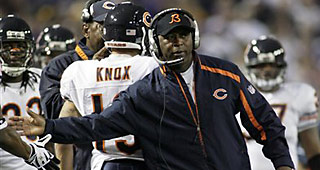
The Bears enter the 2012 season with almost everybody sleeping on them. Chicago's biggest problem is that the NFC North is as tough a place to play as any division. The Packers are an elite team, and the Lions are knocking on the door if they’re not elite already. The Bears are going to need to put together a more balanced team to become a playoff team again.
Before the draft even started, they made three good moves in moving on from Jerry Angelo and Mike Martz, as well as trading a pair of third rounders for Brandon Marshall.
Angelo and Martz were both awful during their time in Chicago and Marshall is the number one receiver that the Bears have lacked for a long time. The Bears entered the 2012 draft looking to get Jay Cutler some weapons, and to infuse the defense with some youth. They accomplished both goals, but didn’t upgrade their offensive line, which was a problem last year.
19: Shea McClellin (OLB-Boise State)
The selection of Shea McClellin bewildered me for a moment at first. Most assumed that McClellin would be on his way to Green Bay or New England, both 3-4 teams that enjoy using exotic defensive looks. McClellin’s greatest strength is his ability to shift all over a defense. DT is the only spot he didn’t play in Boise’s Front-7, and he probably would have played there at times too if Boise wasn’t stacked at the position. The Bears, on the other hand, are one of the most vanilla defenses in the league. They’re a Cover-2 heavy, 4-3 team with the solid and dependable mindset that their scheme would suggest. Every player has a job and is specialized to that role. Why would they bring in the ultimate Swiss Army Knife? Is Lovie (Cover-2) Smith thinking about changing up his defense?
I eventually realized that the Bears aren’t changing their defense, they’re going back to the basics. The rest of the league is abandoning the “base defense.” Several teams spent more time in a Nickel than they did with a traditional Front-7, this year. While the rest of the league shifts to the exotic defensive looks, the Bears are going to play McClellin at the SAM spot and play solid, fundamental, football out of their Base 4-3. It’s not really obvious from his time at Boise, but McClellin is the ideal SAM backer. He’s got ideal size, is good in coverage, can shed blocks, and is a very good blitzer. He makes all the sense in the world as the pick at 19.
Many linebackers in today’s NFL are two-down players. They lack all but the most basic coverage skills. With offenses passing so much, teams are pulling these players and adding another defensive back. The Bears don’t want to do that. They face the Packers and Lions as 25% of their games, both teams use some no-huddle offense and both have versatile offensive players that cause matchup problems for the traditional two down linebacker.
At this point in his career, McClellin’s most NFL level ability is his coverage skills. He can move with a TE or RB and he’s not going to get lost. This is a trait that McClellin shares with the other two Bears’ linebackers. The Cover-2 asks linebackers to cover a lot of territory, something that the Bears’ former SAM, Nick Roach, was incapable of doing. McClellin forms a trio that should succeed in taking away the middle of the field from opposing QBs.
He’s a very solid run defender, with good strength at the point of attack and proper technique to stack and shed blockers. There aren’t many TEs in the NFL that are going to be able to handle Shea in the run game, and he’ll hold his own against many O-Lineman as well. He’s a good blitzer, so good that people mistakenly think that he’s a good edge rusher. He never had much success getting to the QB from a true DE spot, but he had a ton of success getting home on stunts and blitzes up the middle.
45: Alshon Jeffery (WR-South Carolina)
Heading into the 2011 season, Alshon Jeffery was considered a lock to be the first receiver taken. He’d handled pretty much any DB that had been placed in front of him with a rare combination of size, speed, and route running that was somewhat similar to AJ Green from Georgia. He looked like a Top-5 pick.
Then the season opened up, and Jeffery looked like he’d put on some bad weight. He was noticeably slower, and was struggling to get separation because of it. He fell out of the first round on most mocks, and an offseason with extremely negative rumors, hurt his stock even more. While I’ve seen no evidence that Jeffery ever weighed 245+ or ran a 4.7 40, several people I trust believe it. By the time the Combine rolled around, Jeffery weighed in at an acceptable 216 pounds, but he didn’t run or do any of the drills. He had a respectable showing at the South Carolina Pro Day, but Pro Day numbers are not the most reliable.
The first thing you notice about the South Carolina offense is how awful the quarterplay play was. Stephen Garcia may have been a degenerate alcoholic, but at least he wasn’t afraid to throw the ball deep to Jeffery like his replacement, Connor Shaw, was. Jeffery may not be that fast, but he’s still tall and he can still jump, there’s no reason not to throw Jeffery a few fades a game just to see if he can come down with it. Awful QB play and constant double teams, made him look worse than he is.
Jeffery is still tall, he’s still an excellent leaper, and he’s still a solid route runner. It will be interesting to see what happens with his weight and speed. If his speed returns to what it was, the Bears walked away with a Top-5 player in the draft. The alternative scenario is that Jeffery’s weight problems resurface, and he can’t get separation from NFL CBs.
The Bears rolled the dice, but they chose a good player to gamble on. Alshon Jeffery fits the Bears, and the Bears fit Alshon Jeffery. Jay Cutler likes tall receivers, and the Bears really needed some WR help. They traded for Brandon Marshall, who still might be the second most talented receiver in the league, and drafted Jeffery, both of whom will be an improvement over the weapons that the Bears had last year. Look for a revitalized offense with the influx of weapons and the departure of Mike Martz as Offensive Coordinator.
79: Brandon Hardin (Safety-Oregon State)
Brandon Hardin is a really talented player whose stock was lowered due to a lot of injury concerns, including a broken shoulder that caused him to miss the 2011 season. Hardin is a perfect Cover-2 Safety for the Bears, he has good instincts and he covers a lot of ground on the back end. He’s the type of Safety that a team will want to be playing the top part of the bracket on Calvin Johnson.
He’s decent in man coverage, but he’s not going to be a guy that Lovie Smith will want to leave alone. He’s capable of covering the less prolific RBs and TEs but he isn’t going to lock down Jermichael Finley or Brandon Pettigrew.
Hardin isn’t a natural Strong Safety. He’s not a great tackler, despite good size to play the position (6’3 217lbs). The Bears coaching staff is going to want to see that he can hold up before they play him regularly on defense. Limiting his snaps could also help to prevent some of the injuries that he’s suffered in college. He wasn’t asked to blitz much at Oregon State.
111: Evan Rodriguez (FB/TE-Temple)
Listing Evan Rodriguez as a FB or a TE isn’t strictly accurate. If we’re being specific, he spent most of his snaps lined up as a Wing Back. The New England Patriots used Aaron Hernandez as a Wing Back some this year, but the Wing Back hasn’t been popular in the NFL in decades. There are still a few teams in college football that run a Wing offense, like Temple, or the more popular Triple Option offense run by Georgia Tech and Air Force.
The best way to think of Evan Rodriguez is as one of the emerging Power Forward TEs, with a little bit of West Coast Offense pass catching Full Back mixed in. Rodriguez is a very coordinated fluid athlete, and he runs excellent routes for a man pushing 250 pounds. He has solid hands and does a good job of turning up the field and getting yards after the catch.
As a straight ahead blocker, Rodriguez lacks a bit. He’s an occupier, not a hammer. He blocks high, and doesn’t have a ton of power in his game to knock a defender out of the hole. He’s much better blocking to the outside where he can use his quickness to get his feet set and hold up a defender. He’s particularly effective when he can turn the corner, much like a pulling guard trying to keep a crease open. He didn’t spend much time in pass protection and when he did, he had a bad habit of letting guys get inside his pads and move him backwards, which collapses the pocket.
Evan Rodriguez isn’t Aaron Hernandez, but he could be a destitute man’s Aaron Hernandez. Bears’ fans should be excited about this pick, because many of his faults are correctable. His frame is close to maxed out, but technique is Rodrguez’s biggest flaw, and that’s something the Bears will work with him on. It’s difficult to predict whether or not prospects from strange offenses will work out in the pro game, but Rodriguez has all the tools to succeed. It’s going to be up to the Bears to develop him properly, and to find a role that fits his game the best.
184: Isaiah Frey (CB-Nevada)
Isaiah Frey is a player with some raw skills. He’s tall, can run, and does a good job of getting up to deflect the ball. But he needs a lot of work before he’ll be anywhere near ready for Sunday Football. He went up against some less than inspiring competition at Nevada, but he produced at a noteworthy level, which is all that can be asked of him.
Frey’s backpedal is very rough, and his footwork in general is underdeveloped. It prevents him from turning his hips and shadowing receivers as closely as necessary. That’s going to need to be hashed out before he sees the field for the Bears. Until his fundamentals are worked out, he’s going to struggle in both man and zone.
The bigger issue is his lack of physicality. His functional strength isn’t up to par for an NFL corner. He really struggles to misdirect receivers at the line of scrimmage, which is going to be required of him in the NFL. Even more disturbing is his unwillingness to tackle. He won’t be the only corner in the NFL to have problems with tackling, but most have the coverage skills to make up for it. Frey doesn’t at this point. If he doesn’t get more physical, he’s going to have a hard time sticking around on Special Teams, which is his best shot at convincing the Bears that he’s worth keeping around for development.
220: Greg McCoy (CB-TCU)
Greg McCoy was a decent enough corner at TCU, but he’s not an NFL player on his coverage skills alone. He was drafted as a returner, and he’s going to have to show a lot on Special Teams if he’s going to stick around in the NFL. What makes this pick strange is that the Bears already have Devin Hester, who will handle all of the punt return duties. Maybe McCoy plays the kick return spot opposite Hester, but since the NFL has moved up the kickoff line, kickoff return spots aren’t all that important. He’s got okay size, enough to play on kick and punt coverage. He’s not the best tackler, but he isn’t so bad that he can’t be a gunner on kick teams.
In coverage, McCoy struggles getting his hips turned and running with receivers. He’s a decent player in zone coverage, where his quickness allows him to break on the ball, but he can’t be expected to cover receivers man to man in the pros. Despite good speed, he gets beat deep too often. Kendall Wright in particular torched him repeatedly. His ceiling is probably a nickel corner, and if he becomes that and a valuable special teamer, he’ll be well worth his draft slot.
More stories: