The months of March and April signify the beginning or the end for most NFL players. Players who have spent the bulk of their career playing their hearts out for one team are shown the door due to their salary for the following season being too high, and their production for the previous season being a little low.
There is no such thing as loyalty in today?s NFL climate.
As older NFL players retire or move to new teams to start their second and third term careers, new batches of potential new NFL players use this time of year to prove to NFL head coaches and general managers that they are worth a hefty investment that will give a hefty return back to the team in the years to come. The process teams go through prior to drafting a college prospect is no different than the process investors go through prior to investing in a company or companies stock. Neither wants to lose money on their investment, and both expect big returns in a very short period of time. Just like Smith Barney, Merrill Lynch and others, NFL teams spend millions of dollars conducting due diligence on college prospects. Most realize that successfully navigating through this process can sometimes result in holding a trophy while standing on the podium with the commissioner in late February.
For others who fail to manage this process, they will be held responsible for their team?s poor performance and will be out of a job because of it. When a coach or scout stands up for a prospect and convinces others in the organization that he is the right fit, he will forever be tied to that prospects performance for that team. If the prospect looks good and turns into a outstanding player, the entire organization will take credit for it, but if the player turns out to be another Ryan Leaf, well lets just say that the person who went to bat for that player will be most likely searching the want ads with his recently released meal ticket.
I was in Phoenix, AZ a few years ago for the NFL owners meeting. It was in March and two weeks prior to the NFL draft. A friend of mine came out to visit and we both went to a scheduled workout for Arizona State defensive end Terrell Suggs. Suggs was projected as a top 10 pick prior to the combine and evaluation period. Suggs was an All-American who set the record for sacks in a season and career while at ASU. The boy ending his senior season proving that he could be one heck of pass rusher in the NFL. Suggs attended the NFL scouting combine after his season concluded and he had played in a few bowl games. Suggs headed into the combine rated as high as number 2 and 3 on most teams draft boards. All he had to do was show how fast he was and how high he could jump and he was a lock for big early first round bonus money. Suggs elected not to run at the combine like other top prospects. He elected instead to make coaches like Marty shottenhiemer, Herm Edwards, Bill Belechick, Bill Parcells, and others come to his private workout in the desert during the week of the owners meeting.
This is common of high rated picks of today to not run at the combine, so Suggs was just doing what was normal. When we arrived at the Accelerated Performance Academy to watch the workout, there were anywhere from 20 to 25 NFL head-coaches, and at least 30 scouts general managers and owners. The facility we were at, looked like a team facility except bigger and with more modern equipment. It turns out, Suggs? agent paid for his client to train at this facility under the watchful eye of the top physical, mental, and physiological trainers in the country. When Suggs walked out, I turned to my friend and said, ?He looks like he is running for millions of dollars doesn?t he??
Suggs soon took his warm-up off, did a couple of stretches and lined up ready to embark on the most expensive run he would ever make in his life. Suggs looked a little tight when he looked up at me out of his stands as about 50 stop watches were being displayed by coaches and scouts that were lined up ready to see him run. Suggs got to run two 40 yard dashes and 2 shuttle runs. Out of respect I won?t share his times, but lets just say he cost himself millions of dollars.
I turned to my friend told him. ?You just watched someone looe 5 million dollars in .2 seconds.?
While everyone knew Suggs could play, his forty times gave teams an excuse to drop his draft status down and in a twisted way, save them and other teams money in the process. Of course Suggs has turned out to be an outstanding linebacker for the Baltimore Ravens, but he can never recover the money he lost that evaluation day.
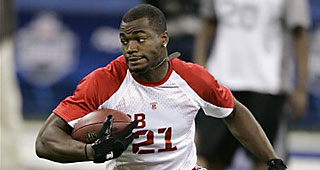
Fast forward to 2007. Oklahoma Running back and first round prospect Adrian Peterson is at the RCA dome faced with the same dilemma as Suggs. Advisors of other draft picks in his position have told their clients not to run. Peterson however does run, and runs well. His time of 4.35 is second fastest at the combine, and he delivers it carrying 218 pounds of muscle. For his performance Peterson should be within the first three picks taken in next months April draft. Hopefully players are starting to understanding that they can help themselves if they consider what the combine is for, and what teams are looking to accomplish by participating in them.
LETTER TO COMBINE PARTICIPANTS:
From: Any NFL TEAM
NFL prospects who are attending these years combine, please understand that as a potential NFL prospect we will be evaluating your services at this years combine. We will not be looking for things you do well; instead we will be looking for things you are not that good at. More than anything we want to find every flaw we can on you so that we can draft you in a later round than what you are supposes to be drafted in. We will use our FBI ties to investigate your entire life history. We will interview old girlfriends, teachers, friends and anyone else who can discredit you with things you may have done in the past. We are looking for evidence of behavioral problems that can be used against you at the negotiating table. Please be aware of the fact that we will use slow 40 times, sprained ankles, and any other injury you may have suffered growing up as negotiation leverage to draft you as late as possible in this years draft. This will save us money, and take money you are probably worth out of your pocket. We like to be upfront with our prospects so there are no surprises when we leak things about you to the media and other teams who may be interested in your services. We might even start a false rumor or two to keep teams from drafted you before the round we want to draft you in. We would like to apologize now for the 32 medical stations you will be put through when you arrive at the combine, and alert you to the fact that we are looking for any injury you may have had dating back to pre-school. We want to warn you that at times our doctors may accidentally pull your arm or knee out of socket a bit to test for stability in the joint. We don?t plan on sharing any of our findings or medical reports with you or your agent at the conclusion of our evaluation, but we will send you a letter thanking you for attending. In conclusion we want you to know that you may find yourself sitting at home on draft day wondering why our team of draft experts has not called your name yet. Announcers will speculate why we and other teams have past on you. However you will never know the real reason.
 RealGM Analysis

More stories: